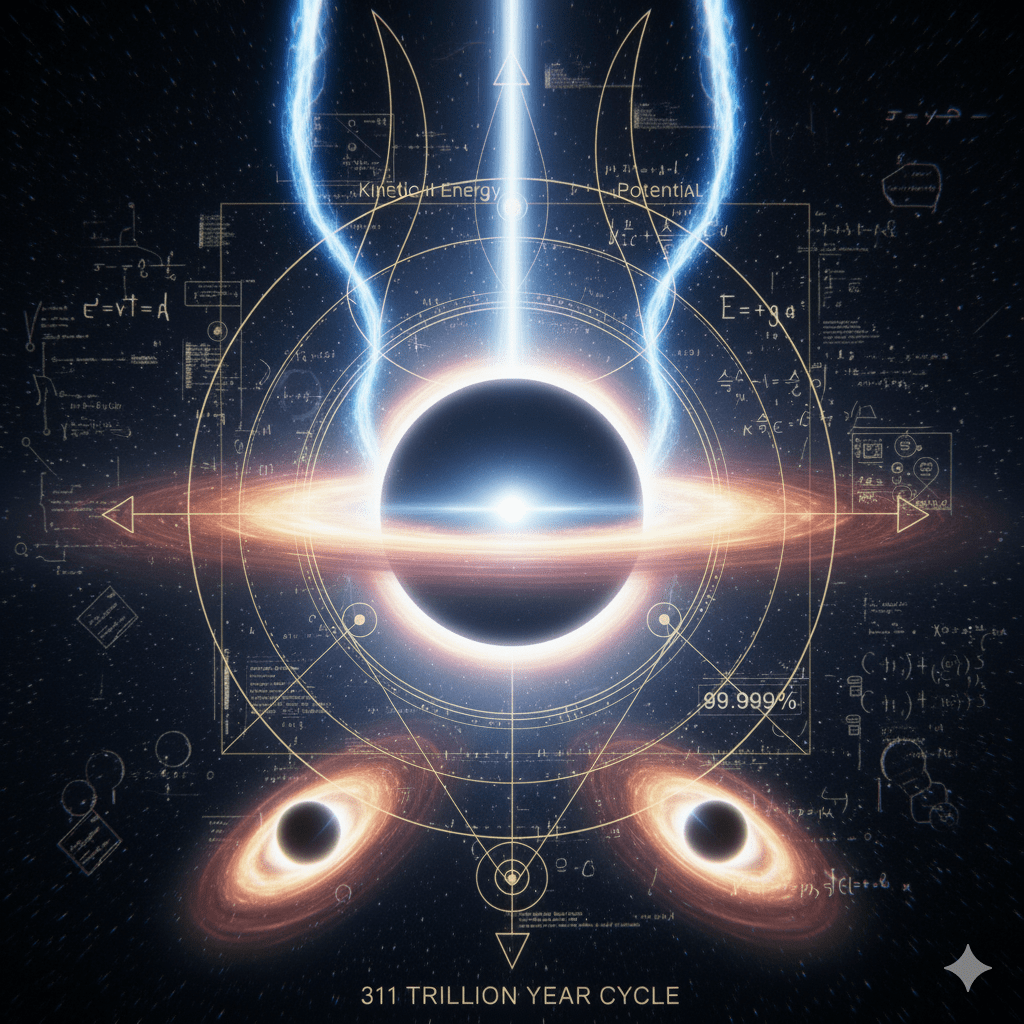
The Event Horizon — The Universal Clutch and the Big Bang Trigger
In our previous chapters, we explored the blueprint of reality in Pi. We also examined the massive hardware of the Supermassive Black Hole (SMBH) systems. For a machine to transition from high-speed rotation to a total reset, it needs a mechanism. This mechanism regulates the flow of energy. Today, we step into the most violent part of the machine: the Event Horizon. This is the Universal Clutch. It is the point where the gears of the old universe slip. The drive-shaft of the new one begins to turn.
The Prabhamandala: Where the Clutch Breaks
In the iconography of Nataraj, Shiva dances within a ring of fire called the Prabhamandala. In the “Metaphysics of the Machine,” this is the Event Horizon.
A clutch in an engine connects the power source to the output. At the edge of a black hole, this boundary is the interface between the “Relative” world and the “Singularity.” When the SMBH gears push the spin to the Extremal Limit, the original world is not just destroyed. It is processed.
1. The Final Countdown: The ‘100 million to 1 billion’ Year Replacement
The gears of the machine don’t merge instantly. They follow a probabilistic timeline known as the Final Parsec Problem.
- The 100 Million Year Grind: Once two Supermassive Black Holes become a binary, there is a 99.9% probability that they will eventually merge, but the timing depends on the “friction” of surrounding stars. It takes approximately 100 million to 1 billion years for them to bleed off enough orbital energy to finally collide.
- The Probabilistic Replacement: Statistically, it is a mathematical certainty that within this timeframe, the larger black hole will consume its smaller partner. This isn’t just a merger; it is a mechanical replacement. The bigger gear consumes the smaller one’s mass to increase its own torque, ensuring the engine has enough “spin” to reach the next phase.
2. The 311 Trillion Year Cycle: The Big Bang Trigger
If the small gear replacement happens every few hundred million years, how long until the entire machine resets? In Vedic cosmology, the life of Brahma is 311.04 trillion years.
- The Cumulative Grind: Over this gargantuan span, millions of SMBH mergers occur across the cosmos. Each merger acts like a ratchet, tightening the angular momentum of the universe.
- The Probability of the Big Bang: As the cycle approaches 311 trillion years, the probability of any single SMBH reaching the “Kerr Limit” (maximum spin) and triggering a universal reset approaches 1.0 (Certainty). There is a 99.999% probability that by the end of this epoch, the gravitational tension is so high that a Naked Singularity must form, causing the “clutch” to break and igniting the next Big Bang.
3. The Dissolution of “Maya” (The Geometric Collapse)
As the engine hits the Kerr Limit at the end of the 311 trillion-year cycle, the grid of spacetime fails. The $2\pi$ circular logic that held atoms together is “overclocked.” The “forms” we know—planets, stars, and biological structures—are stripped of their identity. This is the literal meaning of Samhara. The world is reduced from solid matter back into raw information and pure angular momentum.
4. The Squeeze: Geometry at the Edge
Everything that made the original world unique is forced through a “geometric bottleneck.”
- The High-Torque Arc: Under the crushing force of the Trishul (Kinetic, Rotational, and Potential energies), spacetime is forced into a non-linear trajectory. Light and energy are bent into tight, crescent-shaped arcs.
- The Filtering Process: The “waste” (entropy) is discarded into the heat of the horizon, while the “essence” (the conserved mathematical ratios) is kept. This essence becomes the Sheshnag—the “remainder” small enough to pass through the eye of the singularity.
5. The Opening of the Third Eye
When the cumulative spin of 311 trillion years exceeds the mathematical speed limit, the “Clutch” slips. The Event Horizon—the Veil of Maya—begins to thin.
- Dissolving the Veil: At the poles of the black hole, the barrier between the finite and the infinite dissolves.
- The Gaze of Samhara: Through this Third Eye, the trapped energy is no longer contained. The machine stops “preserving” and begins “transforming,” exposing the Naked Singularity.
6. The Ganga: The Final Exhaust
Just as the Ganga erupts from Shiva’s matted hair, the moment the clutch breaks, a luminous stream is released: the Relativistic Jet.
- The Bhasma (Ash): While the matter is destroyed, the “frequency” of its existence remains etched on the skin of the black hole as a holographic memory. This is the “ash” that covers the Destroyer.
- The Launch: The essence of the original world is “fired” out of the poles at near light-speed. It is a wave-packet of pure potential heading into the void to seed the next Big Bang.
The Finale: The Quantum Bounce
The breaking of the clutch is the moment of Destruction, but in a perfectly designed machine, it is the trigger for ignition. The energy “bounces” through the singularity, and the massive rotational torque of 311 trillion years of mergers becomes the expansion energy of the new universe.
Coming Next: Sheshnag — The Infinite Remainder
The gears have merged. The 311 trillion years are up. The clutch has slipped. How does this data-bridge survive the void? In our final installment, we explore Sheshnag, the serpent of infinity, and how the “Spin” of the old machine becomes the “Entanglement” of the new one.
 हिन्दू विचार
Leave a comment