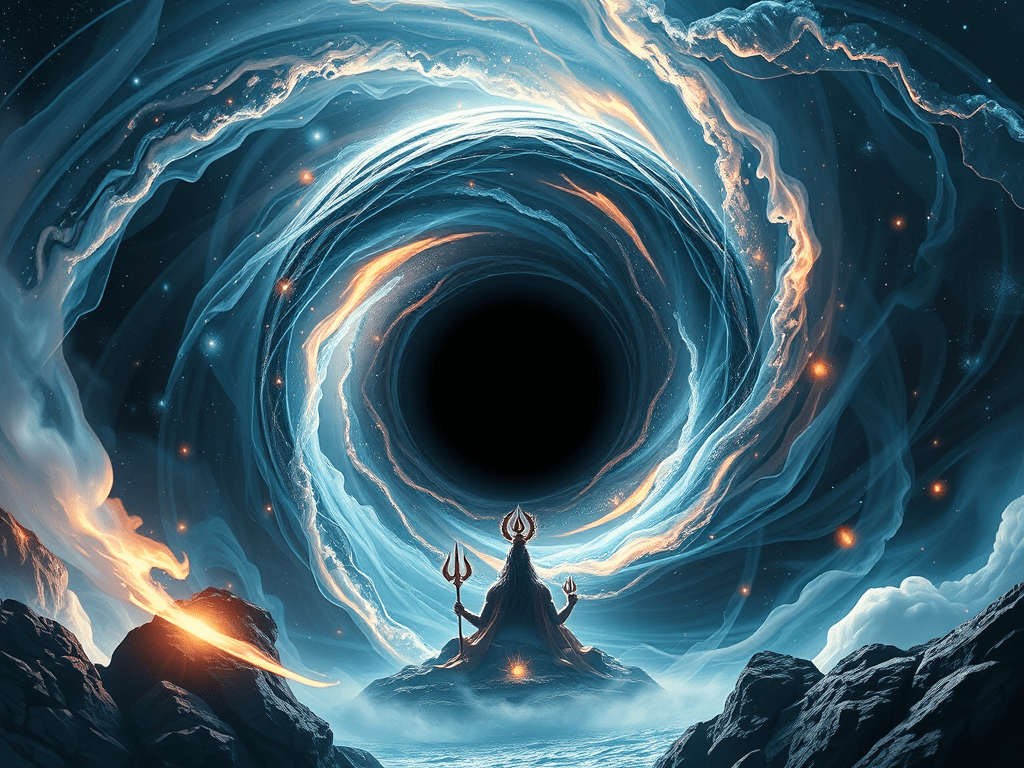
The Gears of the Destroyer
In our first chapter, we decoded the DNA of reality: Pi. We discovered that the universe is built on a circular blueprint that never decays. But a blueprint needs a machine. Today, we step into the engine room of the cosmos to witness the high-torque hardware that drives the cycle of time. We are moving from geometry to power. From math to the Machine.
The SMBH System: The Great Gears of Shiva
If the universe is a machine, Supermassive Black Holes (SMBHs) are its primary gears. These are not merely “holes” in space; they are billion-ton flywheels of concentrated gravity, anchored at the heart of every galaxy.
In ancient metaphysics, this mechanical process was personified by Shiva, the Lord of Transformation. When we look at the anatomy of an SMBH system, we aren’t just looking at physics—we are looking at the physical manifestation of Shiva’s iconic form.
1. The Damru: The Binary Heartbeat
The dance begins with a collision. When two galaxies merge, their central black holes fall toward each other, locked in a gravitational embrace that will last for eons. This is the Damru—the hourglass-shaped drum held in Shiva’s hand.
As these two titans orbit, they create a rhythmic, low-frequency thrum that vibrates the very fabric of the vacuum. This is Frequency Induction. Every rotation is a perfect 2Pi cycle, a mechanical “beat” that pumps energy into the surrounding space. This isn’t just noise; it is the fundamental rhythm that keeps the galaxy’s structure preserved (Sthiti) until the moment of change.
2. The Ganga: The Relativistic Exhaust
Look at the classic image of Shiva, and you will see a jet of water—the river Ganga—erupting from his matted hair. In the engine of an SMBH, we see its twin: The Relativistic Jet.
As the black hole “feeds” on the debris of the galaxy, it reaches a limit. It cannot swallow the energy fast enough. The excess is screamed out of the poles at 99% the speed of light. These jets are the “exhaust” of the cosmic machine, blasting through space for millions of light-years, clearing out old gas and sparking the birth of new stars. It is the life-giving flow produced by the ultimate engine of destruction.
3. The Trishul: The Trident of Power
To drive a machine this large, you need three distinct energies, represented by the three points of the Trishul:
- The Kinetic Spike: The raw, terrifying speed of the orbital dance.
- The Rotational Torque: The spin energy stored in the black holes’ rotation.
- The Gravitational Tension: The “pull” that holds the entire engine together.
When these three forces are balanced, the machine is stable. When they are unleashed, the universe transforms.
4. Opening of Third Eye: The Ascent to the Naked Singularity
This is a “replacement engine.” Over billions of years, the smaller gears are sacrificed to the larger ones. A smaller SMBH spirals into its larger partner, surrendering its entire angular momentum—its “spin”—before being consumed. The bigger gear replaces the small, getting faster, heavier, and more efficient.
The Climax: Eventually, one last merger pushes the spin of the central black hole past the “Kerr Limit”—the mathematical speed limit of the universe.
At this point, the “clutch” of reality slips. The event horizon—the veil that hides the singularity—shatters. The Third Eye is wide open. The Trishul is raised. The Naked Singularity is exposed. This is the ultimate “Samhara”—the moment the machine breaks the laws of physics to trigger a Quantum Bounce, resetting the clock for a new Big Bang.
Coming Next: The Event Horizon Trap
In our next episode, we enter the Prabhamandala—the ring of fire. We will explore the “clutch” of the universe: the Event Horizon. Discover how this boundary acts as a cosmic filter, squeezing the information of one universe into the seed of the next.
The drum is beating faster. The machine is ready to bounce.
 हिन्दू विचार
Leave a comment